Good knife skills do not require a professional kitchen or an expensive set. They require a sharp knife, a few basic techniques and a bit of practice. Once you learn them, chopping becomes faster, safer and more satisfying, and your food cooks more evenly because the pieces are the same size.
Choose the Right Knives
You need only three knives for almost every task.
- A chef’s knife (18 to 20 cm). Your main tool for chopping, slicing and dicing. Choose one that feels balanced and comfortable in your hand.
- A paring knife (8 to 10 cm). For peeling, trimming and small jobs such as hulling strawberries.
- A serrated bread knife. For bread, tomatoes and anything with a tough skin and a soft inside.
One good chef’s knife is better than a block of mediocre ones.
A Sharp Knife Is a Safe Knife
It might seem backward, but dull knives cause more accidents. They require more force and tend to slip. A sharp knife bites into food and goes where you direct it.
- Hone regularly. A honing steel realigns the edge. Use it every few uses to keep the edge straight.
- Sharpen occasionally. A whetstone, a pull-through sharpener or a professional service restores the edge, usually once or twice a year for home cooks.
Set Up Your Workspace
- Use a large cutting board. Wood or plastic is better for your knives than glass or stone.
- Keep the board steady. Place a damp cloth or a non-slip mat underneath so it does not slide.
- Clear the area. Keep only what you need within reach.
- Use separate boards for raw meat and for vegetables, to prevent cross-contamination.
Hold the Knife Properly
Most cooks learn the pinch grip. Pinch the base of the blade, just in front of the handle, between your thumb and the side of your index finger, and wrap the other fingers around the handle. This gives you much better control than holding it by the handle alone, like a hammer.
Protect Your Fingers: The Claw Grip
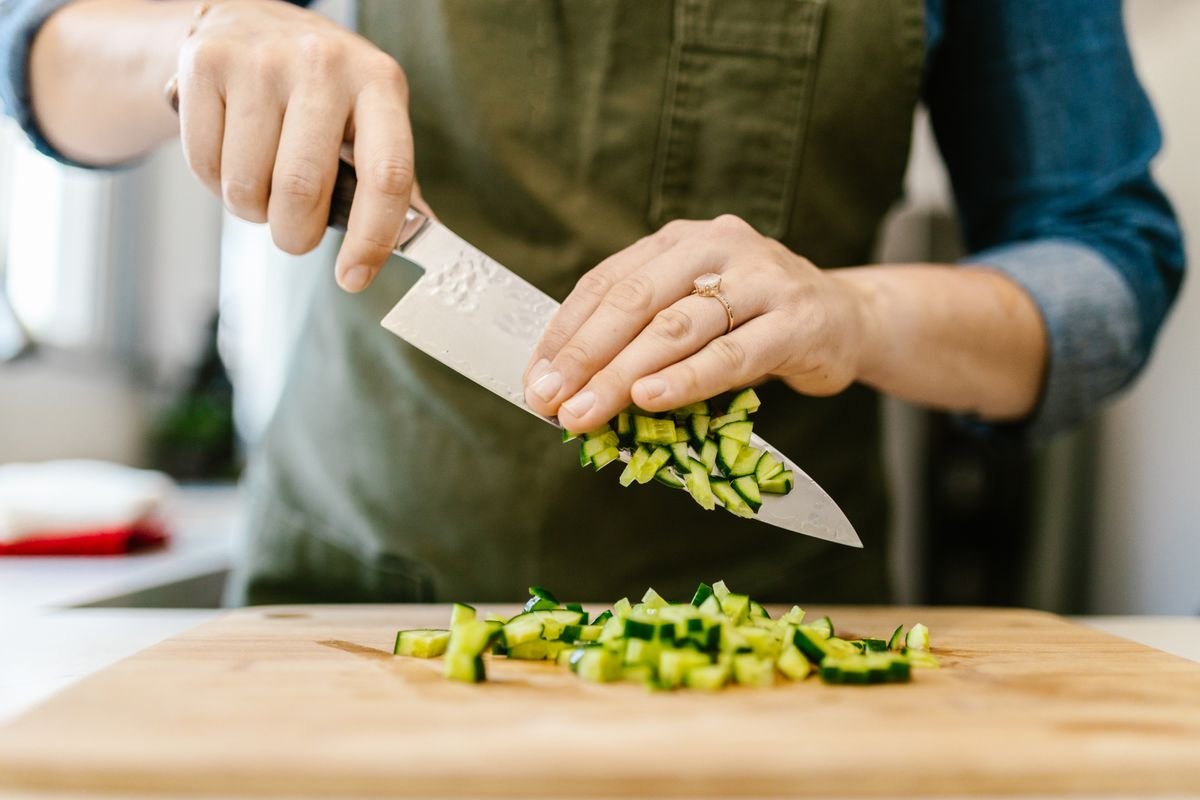
Your other hand holds the food. Curl your fingertips under, like a claw, and keep your thumb tucked behind them. Rest your knuckles against the side of the blade, so the knife glides along them. Your fingertips stay safely out of the way.
The Basic Motions
- The rocking chop. Keep the tip of the knife on the board and rock the blade up and down through the food, moving forward as you go. This is ideal for herbs, garlic and nuts.
- The push cut. Push the knife forward and down through the food, using the whole length of the blade. Good for slicing vegetables.
- The slice. Draw the blade back and forth in a smooth, sawing motion for bread, tomatoes and soft foods.
The Five Cuts Worth Learning
1. Slice. Cutting food into thin, even pieces, such as cucumber or mushrooms.
2. Dice. Cutting into small cubes. First cut the vegetable into even slabs, then into sticks, then across into cubes. Typical sizes are small (about 6 mm), medium (12 mm) and large (20 mm).
3. Chop. A rougher, less precise cut into pieces of roughly the same size. Useful for soups and stews.
4. Julienne. Thin matchsticks, about 3 mm wide and 5 cm long. Good for carrots, peppers and salads.
5. Mince. Chopping very finely, as for garlic, ginger and herbs.
How to Dice an Onion
- Cut the onion in half through the root, and peel it.
- Place one half flat side down. Trim the top, but leave the root end intact, since it holds the layers together.
- Make horizontal cuts toward the root, without cutting all the way through. Two cuts are enough for a medium onion.
- Make vertical cuts from the top toward the root, again leaving the root attached.
- Slice across the onion. Neat dice fall away.
How to Mince Garlic
Crush the clove lightly with the flat of your knife to loosen the skin, then peel it. Slice it thinly, then chop across the slices, rocking the knife until the pieces are fine. A pinch of salt helps the garlic break down.
Stabilize Round Foods
Round vegetables such as carrots, potatoes and squash can roll and slip. Cut a thin slice from one side to create a flat base, then lay the vegetable on it and continue.
Safety Habits
- Cut away from your body and hands.
- Never try to catch a falling knife. Step back and let it drop.
- Wash knives by hand and dry them immediately. Do not leave a sharp knife in a sink full of soapy water.
- Carry a knife with the tip pointing down and the blade pointing away from you.
- Store knives in a block, on a magnetic strip or in blade guards. Never throw them loose in a drawer.
- Focus on what you are doing. Slow down if you are tired or distracted.
Practice Plan
Skills come from repetition, not talent. Try this over a week.
- Day 1 and 2: practice the claw grip and slicing cucumbers and carrots.
- Day 3 and 4: dice onions, aiming for even pieces.
- Day 5: mince garlic and chop herbs.
- Day 6 and 7: make a soup or a salad using all your new skills.
Speed will follow accuracy. Do not rush.
Frequently Asked Questions
Do I need expensive knives?
No. A reasonably priced, well-made chef’s knife that you keep sharp is enough.
How often should I sharpen my knives?
Hone often and sharpen once or twice a year, or whenever the knife begins to struggle with a tomato.
Can I put my knives in the dishwasher?
It is best not to. The heat, detergent and movement can damage the blade and the handle.
Why do onions make me cry?
Cutting releases irritating compounds. A sharp knife, a well-ventilated space and chilling the onion first can help.
The Takeaway
Buy one good chef’s knife, keep it sharp and learn the pinch grip and the claw. Practice a handful of basic cuts until they feel natural. You will cook faster, waste less and enjoy preparing meals much more.